
Travel / THE BUYING BRIEF
Packing cubes that fit your bag, not a fantasy trip.
Choose the footprint, separation and closure around the things you really pack.
 Jonathan LowryPublished October 3, 2026 · 3 min read · sources accessed October 3, 2026
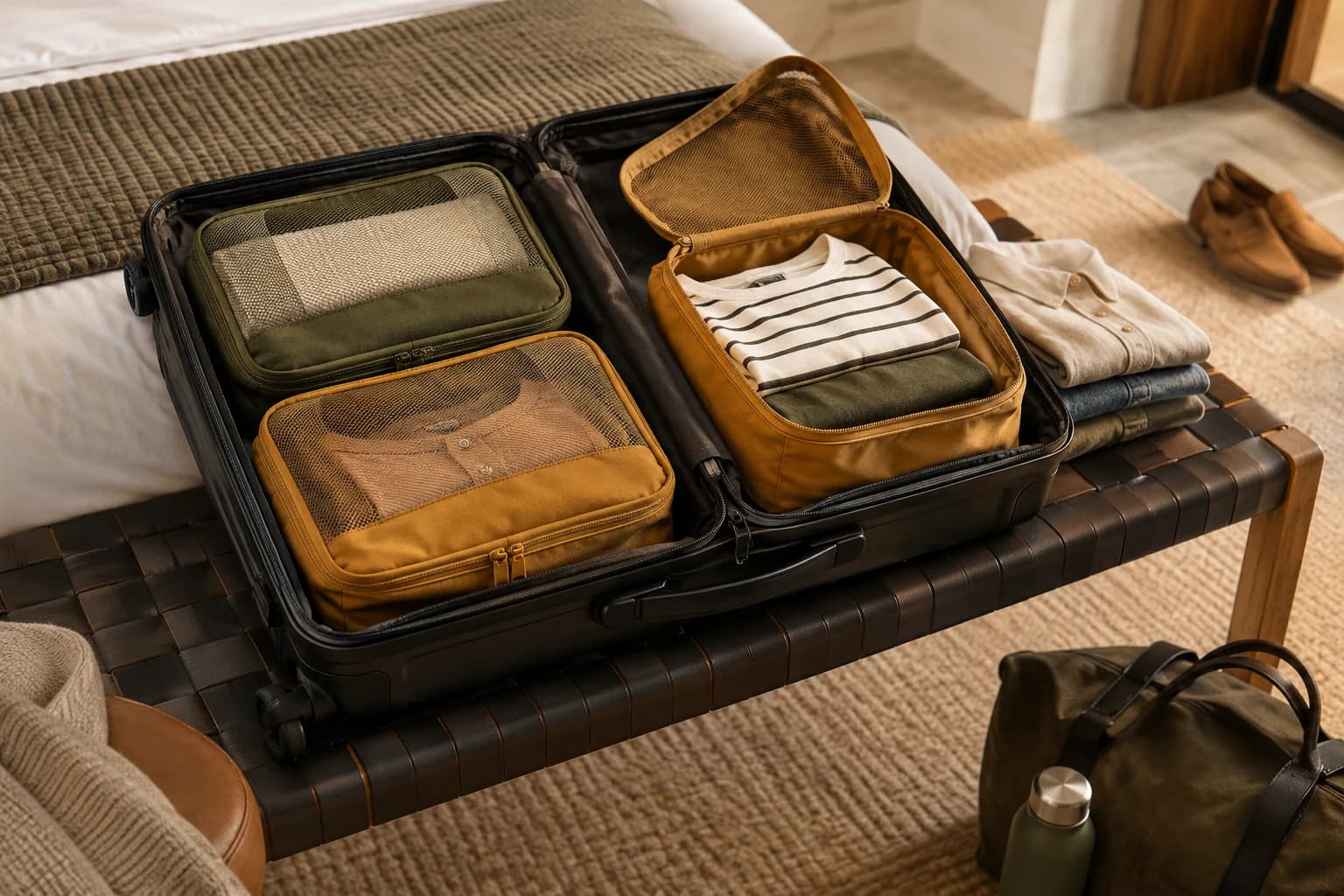
Packing cubes promise order, but a large matching set is not automatically a good match for your suitcase. The useful question is what you want to separate and where each piece will fit. Clothes for a weekend, a longer work trip and a shared family bag can require different arrangements.
This guide treats cubes as a packing system rather than a promise of extra luggage allowance. We have not tested a ranked selection. The aim is to choose dimensions and features you can explain, then compare products that meet that brief without letting the number of pieces in a bundle lead the purchase.
01
Measure usable space inside the bag
Open the bag you intend to use and measure the space around wheel housings, internal pockets and other obstructions. Exterior suitcase dimensions are not the same as usable packing space. Compare a cube's filled dimensions with the area where it will sit, leaving room for shoes, toiletries and the bag's own closures.
For a backpack, consider access as well as volume. A cube may technically fit while making it difficult to reach a laptop sleeve or a jacket. Our practical approach is to sketch a simple layout for the items that must travel together, then choose the cube footprint around that arrangement.
02
Decide what deserves its own compartment
Choose the separation that helps your trip: outfits, smaller clothing, clean and worn items, or one person's clothes in a shared bag. A different size for every task can be useful, but only if you will use those sizes. A coordinated set should earn its space by making packing or unpacking easier for you.
Peak Design's product page illustrates compression and divided storage within one design. Those are manufacturer-described features, not proof that the design is best for your luggage. Check how a specific divider works, whether its space is shared and whether the selected version has the feature shown in the promotional images.
Source: Packing Cube, Peak Design
03
Understand what compression changes
Inspect the closure, the filled dimensions and how the maker describes compressed and expanded states. The headline volume does not show the footprint the cube takes when filled with your clothing. Compare the resulting shape with your bag rather than assuming every compression cube becomes a neat flat rectangle.
Compression is a packing feature, not evidence that the packed items become lighter or that airline weight limits change. Our judgment is to choose it when managing bulk is an important part of your own packing brief. If quick access matters more, pay equal attention to the main opening and the way you unpack.
04
Compare the pieces you will actually use
Read the care instructions, closure details and documented material information. Think about whether you prefer seeing the contents, labeling a compartment or packing by outfit. No material description alone proves a cube will withstand your particular travel routine; broad durability promises need more than a maker's campaign language.
At checkout, list the included sizes and number of pieces. Compare the delivered set with a smaller combination that covers the same needs. Confirm the bag layout again and check returns before filling the cubes. The right purchase is the arrangement you can pack, access and maintain, not necessarily the most extensive bundle.
THE SHORTLIST STARTS HERE
Three directions to compare
Start with the approach that fits your needs, then compare the details that matter to you.
Simple organizers
Separate clothes or outfits with sizes that fit the bag's usable footprint.
The trade-off: More compartments can add packing steps rather than convenience.
Compression designs
A bulk-focused brief with verified expanded and filled dimensions.
The trade-off: Compression does not change packed weight or carrier limits.
Divided-storage designs
A documented clean/worn or other separation feature you will use.
The trade-off: Compartments can share space; inspect how the design works.
SAVE YOURSELF THE SURPRISE
Before checkout
- Usable bag interior measured.
- Cube dimensions checked when filled.
- Separation job chosen.
- Bundle contents recorded.
- Closure and care instructions read.
- Space for other essentials retained.
MAKE IT PERSONAL
Bring your brief to the concierge.
Start with this, then add the details that matter to you:
“Help me choose packing cubes for my actual bag and trip.”
Find my options ↗Sources
- Packing Cube
Peak Design · manufacturer · Accessed October 3, 2026
Compression and divided-storage design example. Regional storefront and exact model dimensions must be checked at purchase.
ANOTHER GOOD QUESTION